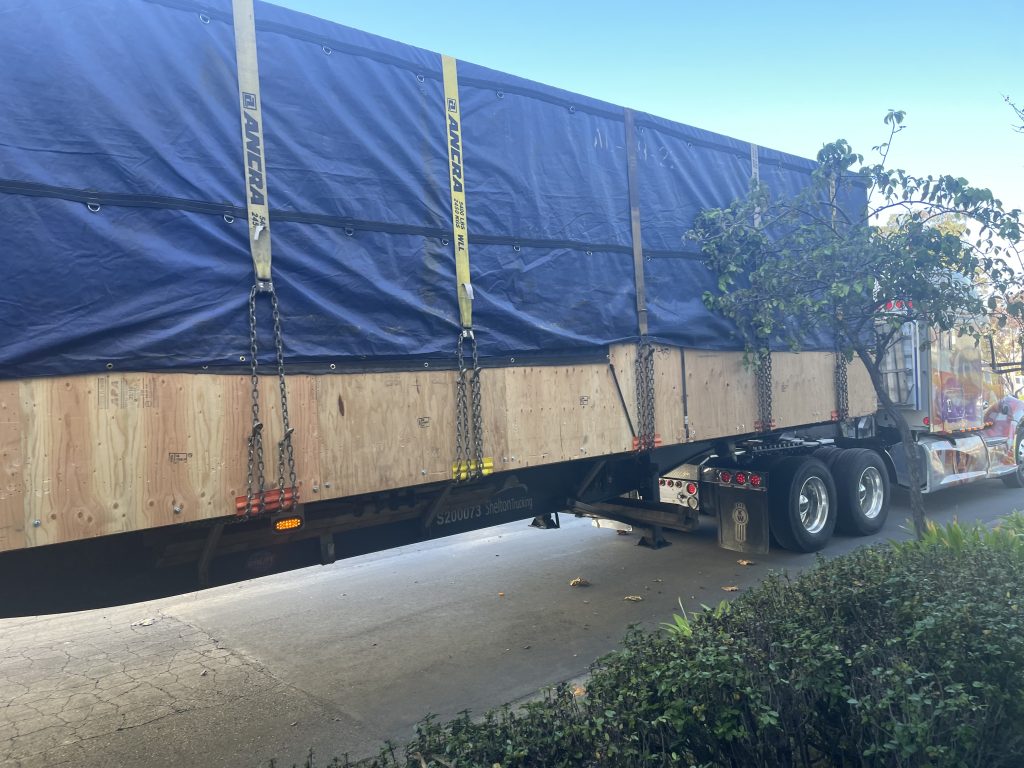
Each state has laws that that define legal dimensions for loads. Any load greater than these state set limits makes the load oversized. These oversize loads must be permitted to be legally transported. There are five basic types of oversize loads:
- Over Height Loads – Loads higher than the legal limit. For most states this is 13 feet 6 inches but could be more depending on the states in which you are running.
- Over Width Loads – These loads are wider than legally allowed. For most states this is 102 inches. PS Logistic trailers are 102 inches wide, so anything load that is wider than the rub rails on the trailer makes the load oversize.
- Over Length Loads – The rules for legal load length vary greatly from state-to-state. Any load longer than 53 feet could be oversize depending on the states in which you are driving.
- Overhanging Loads – Many states have limits on how far a load can hang over the front and rear of the trailer. This varies from state to state. The most common regulation is up to 4 feet off the rear of the trailer (some states are less).
- Overweight Loads – If the combined weight of the truck, trailer, and load is greater than 80,000 pounds the load is oversized.
Additional Equipment
Hauling an oversize load will require additional equipment. What is needed will vary depending on the dimensions of the load and the state it is being transported through. Required additional equipment will be listed on the load permits issued by the state. This includes but is not limited to the following:
- Oversize Load Banner– 7ft x 1.5ft yellow banner with 10-inch black letters reading “OVERSIZE LOAD”. “WIDE LOAD” banners are not legal in many states. Be sure to have the proper banner.
- Safety Flags– These are 18-inch square red flags. These may be required on the front corners of the tractor, on the corners of the load, or at the rear of the load depending on permit requirements. These can be mounted to the tractor or load in different ways.
- Beacon Lights– Rotating or strobing yellow lights may need to be mounted on both the top of the tractor and the load.
Pilot Cars
Some loads that exceed certain dimensions may require the use of pilot cars or escort vehicles. These cars, typically passenger vehicles, assist the driver in moving down the highway. These cars help a driver spot problems, obstacles, interferences, and communicate them back to the driver. Escorts also can assist the driver by blocking traffic for safe lane changes and tight turns. Working with pilot services requires a CB radio and good communication skills to coordinate movement.
Permits
Oversize load permits will be obtained by operations before the load moves. The driver must keep a copy of this permit in his truck while hauling the load. Always read your permits carefully to ensure compliance with state laws for oversize loads. This includes the following:
- Requirements for additional equipment and placement of these devices.
- Legal moving hours – Many loads will be restricted to daylight hours only. A driver will need to plan his or her trip with this in mind.
- Routing- Some loads will require you to take exact routes to get to your destination. These routes are planned to avoid heavy traffic, narrow roads, narrow and weight restricted bridges, low clearance obstacles, and other problems that may not be obvious.
On The Road
Each type of oversize load presents different challenges to truck drivers. Here are few things to consider.
- All oversize loads must stop at ALL open weight stations and present the permits for the loads. This will increase the chance of inspection by DOT officers.
- Wide loads will hang into adjacent lanes and over the shoulder of the road. A driver must watch traffic, as well as roadside hazards such as parked vehicles, utility poles, and mailboxes that are close to the edge of the road.
- Long loads take much more room to turn than legal sized loads. This will require more space to swing wide. This swing can create situations in which traffic moves in beside the trailer during the turn. A driver must have a good circle of awareness and keep his or her eyes moving to see developing problems.
Overhanging loads create tail swing. Tail swing is a side-to-side motion that can be outside the path of the wheel while the trailer is turning. Drivers must compensate for this when turning and backing, particularly in tight areas and during backing.
Example of combining a strap and a chain on a load that is too large for a strap to reach by itself.