Precast Concrete – Stadium Stairs
- Chains should only be placed over dunnage supporting the load.
- Total amount of chains needed shall be at least one more chain that required per FMCSA guidelines.
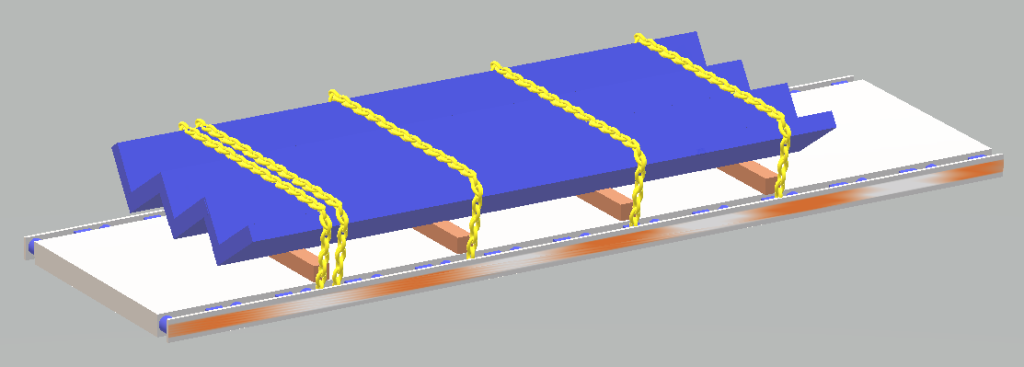
| Figure 1: Stadium stairs secured with 5 chains. Notice how each chain is thrown over the steps over the supporting dunnage. |
Points to Remember
- Edge protection must be used anywhere the chain comes into direct contact with the concrete.
- If the load is oversized be sure all required oversized signage and equipment is properly installed. This may include but is not limited to flags, banners, and strobe lights.
Back to Top
Precast Concrete – Double Tees
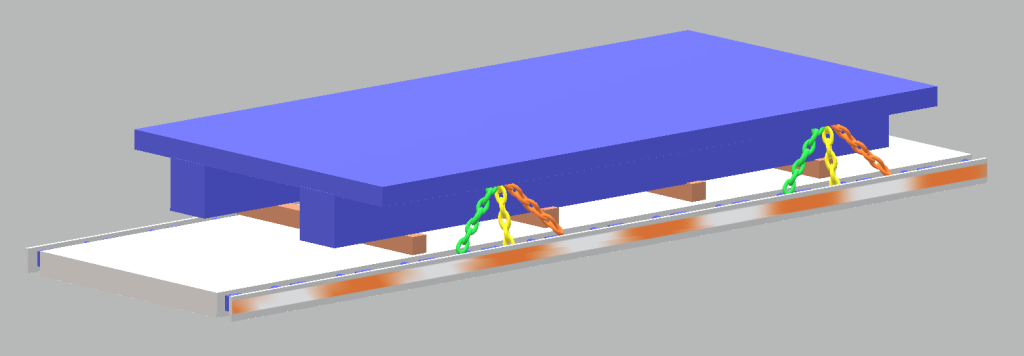
| Figure 1: 45,000lb Double T secured with six chains. Notice how the green chains pull forward while the orange chains pull backwards to prevent motion. All six chains pass through the conduit pockets on the vertical faces of the t’s. Use only conduit pockets located directly above supporting dunnage. |
Points to Remember:
- Chain over the whole piece should be avoided if possible. If a driver must go over the whole piece care must be taken not to over tighten that chain. The outer wings of the double T will NOT support a great deal of weight and can easily be damaged.
- Edge protection must be used anywhere the chain comes into direct contact with the concrete.
- Any load wider that 102 inches will require oversize load permits. Requirements for these loads can vary from state to state depending on dimensions and weight.
- Be sure all required oversized signage and equipment is properly installed. This may include but is not limited to flags, banners, and strobe lights.
Back to Top
Precast Concrete Wall Panels- Flat on Deck
- The number of chains used to secure the load shall be one more chain than is required by standard FMCSA standards for cargo securement.
- Chains should only be placed over the product where there is dunnage underneath the load. Placement of chain anywhere else over the product can result in damage.
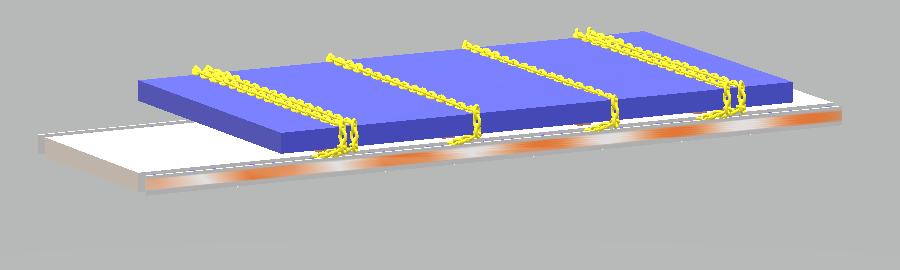
| Figure 1: 42,000lbs wall panel secured with six chains. Each chain over a block of dunnage to |
Points to Remember:
- All chain must have edge protection where it touches the panel.
- Front most chain on the load should not be forward of the first block of dunnage.
- Rear most chain on the load should not be further back that the last block of dunnage.
- Any load wider that 102 inches will require oversize load permits. Requirements for these loads can vary from state-to-state depending on dimensions and weight.
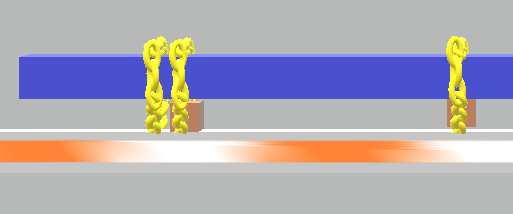
| Figure 2: Side view showing chains over the blocking. |
- Be sure all required oversized signage and equipment is properly installed. This may include but is not limited to flags, banners, and strobe lights.
Back to Top
Precast Concrete – Columns
- 2 chains should be placed over the first 5ft of the load, then one additional chain every 8ft back down the remainder of the load.
- When possible, a chain should be placed around the front of the load to help prevent forward motion.
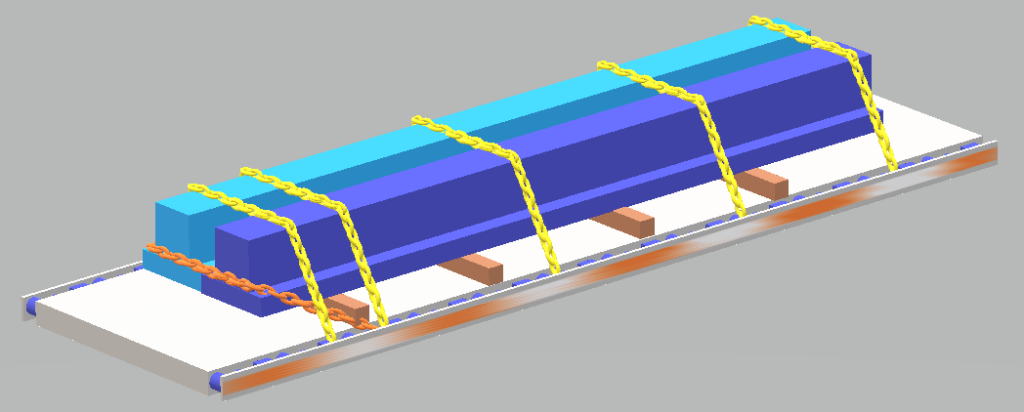
| Figure 1: Two precast columns loaded side-by-side. Note the two chains in the first 5ft than an additional chain every 8ft back (shown in yellow). An additional chain (orange) is added to prevent forward motion. |
Points to Remember:
- Edge protection must be used anywhere the chain comes into direct contact with the concrete.
- If the load is oversized be sure all required oversized signage and equipment is properly installed. This may include but is not limited to flags, banners, and strobe lights.
Back to Top
Rinker Precast Concrete – Bridge Decking
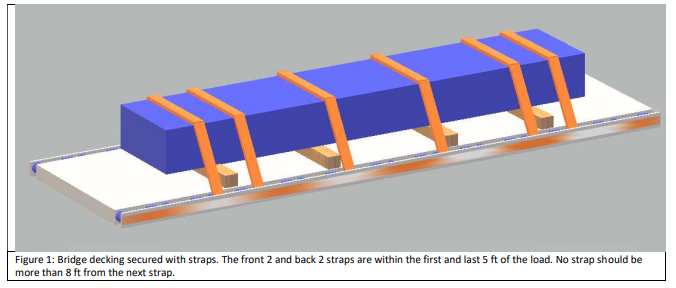
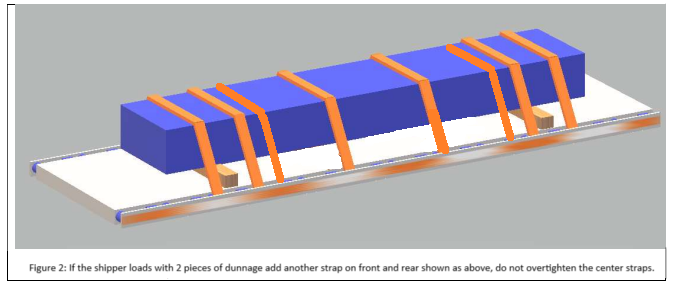
1.) A decking load can be one piece or multiple pieces.
2.) Two tie-downs must be placed over the first 5ft of the load.
3.) Place two tie-downs over the rear 5 ft of the load.
4.) Place one tie-down every eight feet between the front and rear sets of tie-downs.
Back to Top
Rinker Precast Concrete – Culvert Boxes (Square)
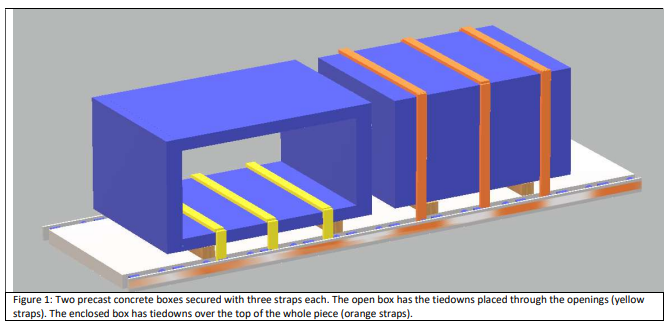
1.) Each box must be secured individually.
2.) For enclosed boxes, tiedowns should be placed over the top of the box.
3.) For open boxes, tiedowns should be place through the open sides.
4.) A minimum of 2 tiedowns is required for each piece.
5.) For the correct number of tiedowns per piece, see the chart below.
| Weight (lbs.) | 0-9000 | 9000-18000 | 18000- 27000 | 27000- 36000 | 36000- 45000 | 45000- 54000 |
| Of tiedowns | 2 | 3 | 4 | 5 | 6 | 7 |
Points to Remember:
- Edge protection must be used every place a strap touches the product.
- If a box is wider than the rub rails of the trailer it is considered oversize and will require
- permits to be hauled.
Back to Top
Rinker Precast Concrete- Barrier Rail
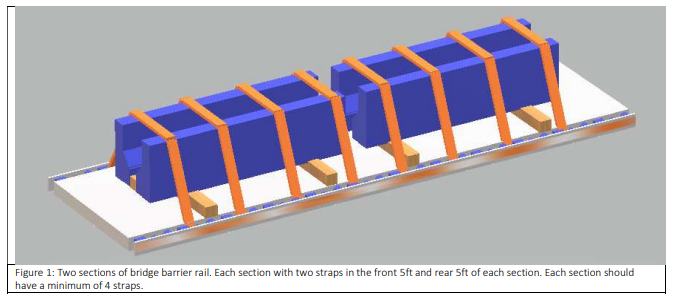
1.) Barrier rail is to be loaded with the shortest sides facing each other. This keeps the
center of gravity toward the center of the trailer to prevent tipping.
2.) Blocking may be placed between the two pieces to help stabilize the load.
3.) Place two tiedowns in the first five foot of each section.
4.) Place two tiedowns in the last five foot of each section.
5.) No more than 8 ft should be between tiedowns.
Points to Remember:
- Edge protection must be used every place a strap touches the pieces.
- A minimum of 4 tiedowns should be used on each section.
Back to Top
Rinker Precast Concrete – Bridge Arches
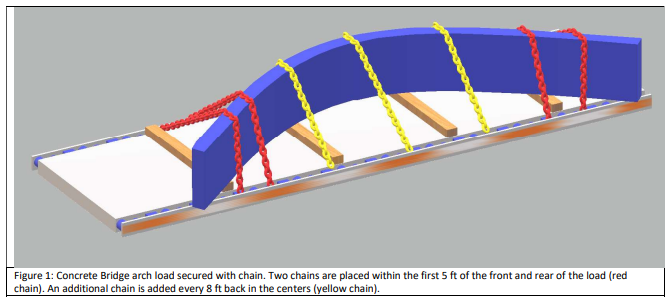
1.) Two tie-downs must be placed over the first 5ft of the load from where the arch crosses
the rub rail.
2.) Place two tie-downs over the rear 5 ft of the load from where the arch crosses the rub
rail of the trailer.
3.) Place one tie-down every eight feet between the front and rear sets of tie-downs.
Points to Remember:
- Edge protection must be used every place a tiedown touches the freight.
- These loads will be oversize and will have to be permitted to be hauled. Please see the oversize section of this manual.
- Because of the shape and size of this load chain is required.
Back to Top
Oversize Loads
Each state has laws that that define legal dimensions for loads. Any load greater than these
state set limits makes the load oversized. These oversize loads must be permitted to be legally
transported. There are five basic types of oversize loads:
1.) Over Height Loads – Loads higher than the legal limit. For most states this is 13 feet 6
inches but could be more depending on the states in which you are running.
2.) Over Width Loads – These loads are wider than legally allowed. For most states this is
102 inches. PS Logistic trailers are 102 inches wide, so anything load that is wider than
the rub rails on the trailer makes the load oversize.
3.) Over Length Loads – The rules for legal load length vary greatly from state-to-state. Any
load longer than 53 feet could be oversize depending on the states in which you are
driving.
4.) Overhanging Loads – Many states have limits on how far a load can hang over the front
and rear of the trailer. This varies from state to state. The most common regulation is up
to 4 feet off the rear of the trailer (some states are less).
5.) Overweight Loads – If the combined weight of the truck, trailer, and load is greater than
80,000 pounds the load is oversized.
Additional Equipment
Hauling an oversize load will require additional equipment. What is needed will vary depending on the dimensions of the load and the state it is being transported through. Required additional equipment will be listed on the load permits issued by the state. This includes but is not limited to the following:
- Oversize Load Banner- 7ft x 1.5ft yellow banner with 10-inch black letters reading “OVERSIZE LOAD”. “WIDE LOAD” banners are not legal in many states. Be sure to have the proper banner.
- Safety Flags– These are 18-inch square red flags. These may be required on the front corners of the tractor, on the corners of the load, or at the rear of the load depending on permit requirements. These can be mounted to the tractor or load in different ways.
- Beacon Lights– Rotating or strobing yellow lights that may need to be mounted on both the top of the tractor and the load.
Pilot Cars
Some loads that exceed certain dimensions may require the use of pilot cars or escort
vehicles. These cars, typically passenger vehicles, assist the driver in moving down the highway.
These cars help a driver spot problem, obstacles, interferences, and communicate them back
to the driver. Escorts also can assist the driver by blocking traffic for safe lane changes and tight
turns. Working with pilot services requires a CB radio and good communication skills to
coordinate movement.
Permits
Oversize load permits will be obtained by operations before the load moves. The driver must
keep a copy of this permit in his truck while hauling the load. Always read your permits carefully
to ensure compliance with state laws for oversize loads. This includes the following:
- Requirements for additional equipment and placement of these devices.
- Legal moving hours – Many loads will be restricted to daylight hours only. A driver wil need to plan his or her trip with this in mind.
- Routing- Some loads will require you to take exact routes to get to your destination.
These routes are planned to avoid heavy traffic, narrow roads, narrow and weight
restricted bridges, low clearance obstacles, and other problems that may not be
obvious.
On The Road
Each type of oversize load presents different challenges to truck drivers. Here are few things to
consider.
- All oversize loads must stop at ALL open weight stations and present the permits for the loads. This will increase the chance of inspection by DOT officers.
- Wide loads will hang into adjacent lanes and over the shoulder of the road. A driver must watch traffic, as well as roadside hazards such as parked vehicles, utility poles, and mailboxes that are close to the edge of the road.
- Long loads take much more room to turn than legal sized loads. This will require more space to swing wide. This swing can create situations in which traffic moves in beside the trailer during the turn. A driver must have a good circle of awareness and keep his or her eyes moving to see developing problems.
- Overhanging loads create tail swing. Tail swing is a side-to-side motion that can be outside the path of the wheel while the trailer is turning. Drivers must compensate for this when turning and backing, particularly in tight areas and during backing.