Table of Contents
- Section 1 | Introduction to Concrete Pipe
- Section 2 | Loading Concrete Pipe
- Section 3 | Bell Pipe
- Section 4 | Concrete Pipe (Inside diameter 45 inches or less) with longitudinal cable system
- Section 5 | Concrete Pipe (Inside diameter 45 inches or less) with no longitudinal cable system
- Section 6 | Concrete Pipe (Inside diameter more than 45 inches)
- Section 7 | Concrete Pipe (Inside diameter more than 45 inches) Singles
- Section 8 | Concrete Pipe – Round, Eye Vertical
- Section 9 | Regulations- FMCSR 393.124
- Section 10 | Oversize Loads
Introduction to Concrete Pipe
Securement regulations for concrete pipe are different from other types of commodities. Concrete pipes have their own regulations, which can be found in the Federal Motor Carrier Safety Administration Regulations Handbook (FMCSR) in section 393.124. These special regulations apply to all concrete pipe except those loaded eyes vertical and those loaded eyes forward (or lengthwise). Securing concrete pipe requires high level cooperation between the shipper and the driver in order to be compliant and secured. Concrete pipe is subject to all general cargo securement requirements for the number and placement of tiedowns.
Shipper’s Role
It is important that shippers understand the unique regulations regarding concrete pipe. Shippers should educate their loaders and operators on the correct securement and also proper loading techniques for concrete pipes.
Driver’s Role
The driver must be able to spot any loading issues and report them back to the shipper. These issues must be corrected prior to departure. The driver is responsible for safely and legally securing the load before departing. If the load cannot be safely and legally secured, drivers are to report it to the shipper and their driver manager.
Pipe Sizes
Securement regulations divide concrete pipe into two different categories:
- Medium Pipe- Inside diameter of 45 inches or less.
- Large Pipe- Inside diameter of more than 45 inches.
Wood Blocking
Wooden blocking at the front and rear of sections must meet the following criteria: A single block must be at least half the width of the pipe it is holding. A full 8ft timber is preferred.
Blocking must not be smaller than 4 inches by 6 inches (4×6) timber. This is a regulation that can be found 393.124(c)(4)
Edge Protection
Proper edge protection is a must when hauling concrete pipe. Concrete pipe is very abrasive and will quickly damage webbing straps. Chain can chip and damage concrete edges. Edge protection must be used anywhere the tiedown contacts the freight.
Back to top
Loading Concrete Pipe
Bottom Tier / Single tier loads
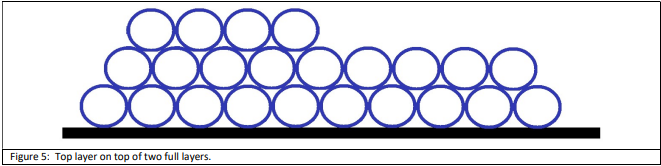
- Bottom tier must be loaded down the full length of the trailer or as a partial tier in one or two sections. 3 separate sections are not allowed per FMCSA regulation.
- The front and rear pieces of pipe must be immobilized by blocking, vehicle structure, stakes, or locked pipe unloader.
- Each pipe in the bottom layer must be held firmly in contact with the pipe directly to
- front and rear of that piece.

Second Tier
- Pipe in the second layer can only be placed in the wells or grooves formed by the pipe inthe first layer.
- Pipe in the second tier can be loaded in one section or two. 3 separate sections are not allowed by FMSCA regulations.

Third Tier
- A third or higher layer can only be started if all the wells on the lower layers are filled.
Back to top
Bell Pipe
Bell pipe must follow the same set up as shown on the previous page in addition to the
following requirements.
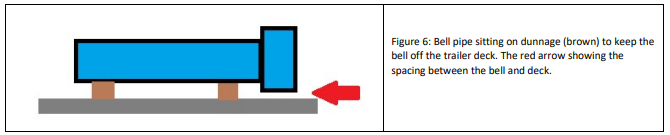
- All bell pipe must be loaded on wood spacers tall enough to prevent the bell from touching the deck of the trailer.
Single Layer Bell Pipe
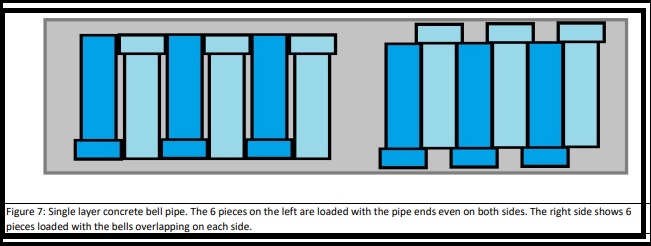
- Single layer bell pipe must be loaded so that the bells are on alternating sides of the trailer.
- This can be done by loading the pipe ends even on the trailer or by overlapping the bells on each side.
Multiple layer bell pipe
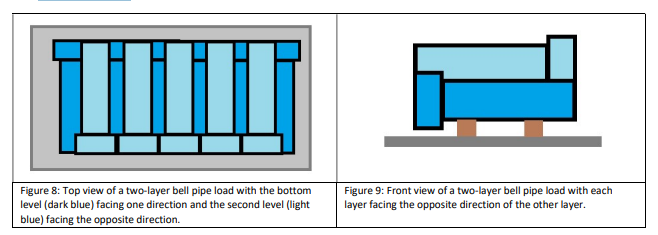
- Bottom level of pipe must be loaded with all the bells facing the same direction on the trailer.
- Second level of pipe must be loaded with all the bells facing the opposite direction of the bottom layer.
- If a third level is used, the bells must be loaded in the opposite direction from the second level.
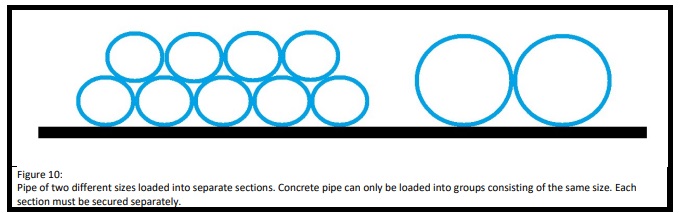
Multiple Sizes of Concrete Pipe
- If pipe of more than one diameter are loaded on the trailer, groups must be formed that have only one size of pipe.
- These groups must be secured separately from each other.
Back to top
Concrete Pipe (Inside diameter 45 inches or less) with longitudinal cable system
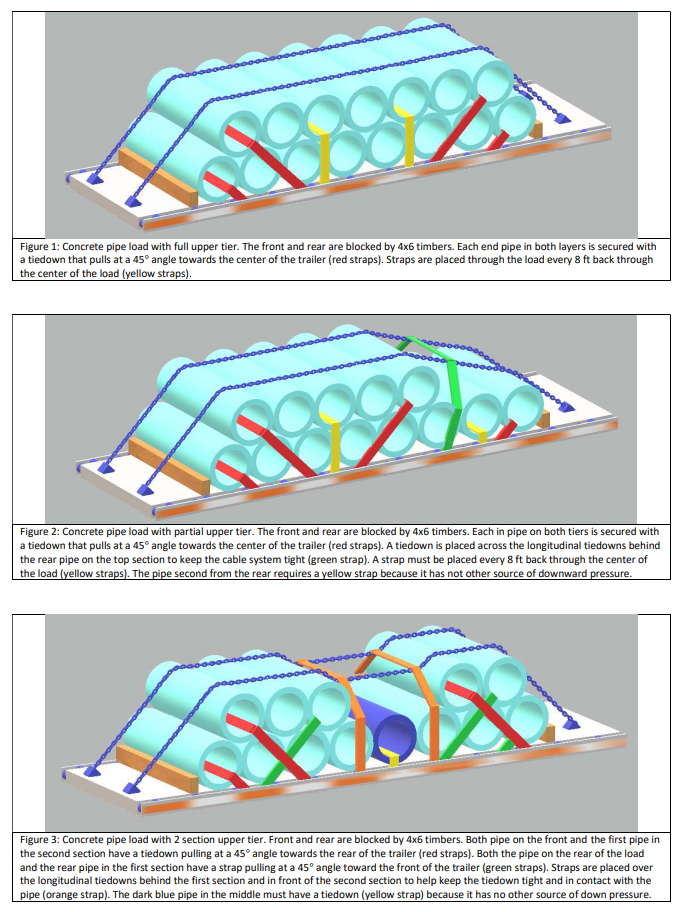
- The front of the bottom layer must be immobilized with a wooden blocking to prevent rolling. This blocking must be no smaller than a 4-inch by 6-inch (4×6) timber. If using a step deck trailer this can be skipped if the pipe is loaded against the front the step of the trailer
- The rear of the bottom layer must be immobilized with wooden blocking to prevent rolling. This blocking can be no smaller than a 4×6 timber.
- The front pipe on each additional tier must be secured with a tiedown that pulls towards the rear of the trailer at a 45° angle or less. This must be done to both sections if multiple sections are loaded.
- The rear pipe on each additional tier must be secured with a tiedown that pulls toward the front of the trailer at a 45° angle or less. This must be done on both sections if multiple sections are loaded.
- Two cables should be placed over the length of the load.
- If the upper layer is not full or if the upper level is two sections, tiedowns should be placed over the cable behind the last pipe to keep the cable tight against the pipe.
- Tiedowns should be placed over the load down its length with no more than 10 ft between tiedowns. These can go through the pipe on the top layer or over the top of the load over the longitudinal (lengthwise) cable.
Points to Remember:
- Edge protection must be used every place a tiedown touches the pipe.
- Every pipe must have downward pressure from the cables, another piece of pipe, or a tiedown through it.
Back to top
Concrete Pipe (Inside diameter 45 inches or less) with no longitudinal cable system
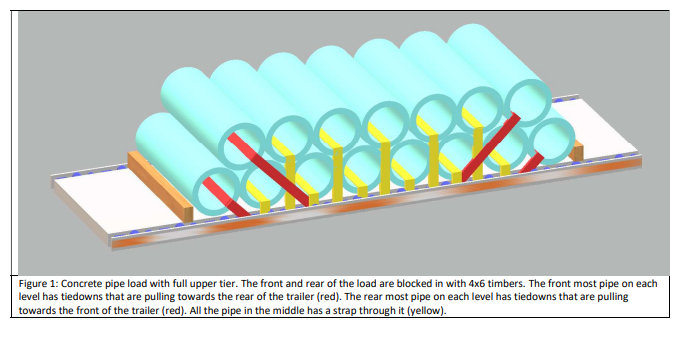
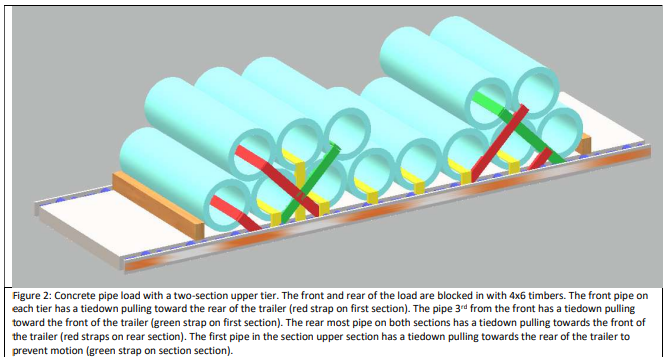
- The front of the bottom layer must be immobilized with a wooden blocking to prevent rolling. This blocking must be no smaller than a 4-inch by 6-inch (4×6) timber. If using a step deck trailer this can be skipped if the pipe is loaded against the front the step of the trailer.
- The rear of the bottom layer must be immobilized with wooden blocking to prevent rolling. This blocking can be no smaller than a 4×6 timber.
- The front pipe on each tier must be secured with a tiedown that pulls towards the rear of the trailer at a 45° angle or less. This must be done to both sections if multiple sections are loaded.
- The rear pipe on each tier must be secured with a tiedown that pulls toward the front of the trailer at a 45° angle or less.
- Every pipe on the trailer must have a tiedown through the pipe.
Points to Remember:
- Edge protection must be used every place a tiedown touches the pipe.
Back to top
Concrete Pipe (Inside diameter more than 45 inches) In
Groups
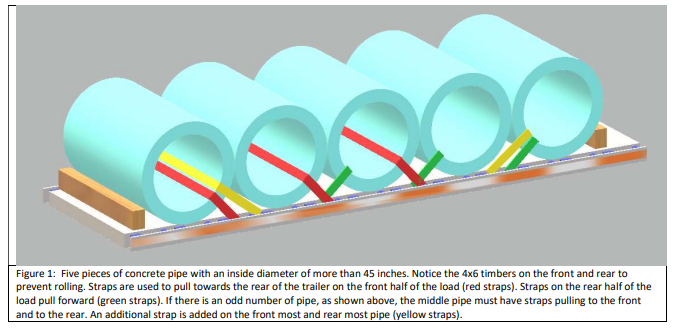
1.) The front pipe must be immobilized with wooden blocking to prevent rolling. This
blocking must be no smaller than a 4-inch by 6-inch (4×6) timber. If using a step deck
trailer this can be skipped if the pipe is loaded against the front step of the trailer.
2.) The rear of the pipe must be immobilized with wooden blocking to prevent rolling. This
blocking can be no smaller than a 4×6 timber.
3.) Tiedowns must pass through each pipe.
4.) If the front most pipe is not against a vehicle structure it requires 2 tiedowns pulling
towards the rear of the trailer. These should be 45° or less.
5.) The rear most pipe requires two tiedowns pulling towards the front of the trailer.
6.) On the front half of the load at least one tiedown must pull toward the rear of the truck
on each pipe. If there are an odd number of pipe the middle pipe is included. These
should be 45° or less.
7.) One the rear half of the load at least one tiedown through each pipe must pull towards
the front of the truck. If there is an odd number of pipe, the middle pipe is included.
These should be 45° or less.
Points to Remember:
- Edge protection must be used every place a tiedown touches the pipe.
- Aggregate working load limits for the tiedowns used must be equal or greater than one half the weight of the pipe it is holding.
Back to top
Concrete Pipe (Inside diameter more than 45 inches)
Singles
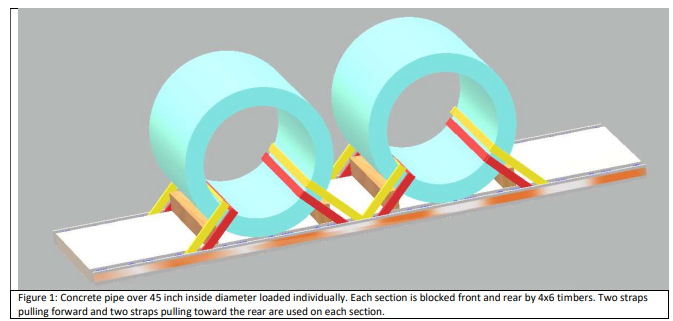
1.) Each pipe must be immobilized front and rear on the front and rear of the pipe to
prevent rolling. Wooden blocking used for this must be no smaller than a 4-inch by 6-
inch timber.
2.) Tiedowns must pass through the pipe.
3.) Two tiedowns must pull towards the rear of the trailer. If the front most pipe is not
against a vehicle structure it requires 2 tiedowns pulling towards the rear of the trailer.
These should be 45° or less.
4.) The rear most pipe requires two tiedowns pulling towards the front of the trailer. These
should be at a 45° or less.
Points to Remember:
- Edge protection must be used every place a strap touches the pipe.
- Aggregate working load limits for the tiedowns used must be equal or greater than one half the weight of the pipe it is holding.
Back to top
Concrete Pipe- Round, Eye Vertical
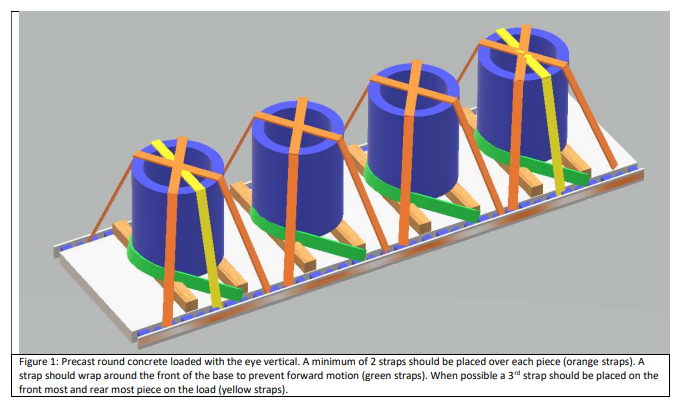
1.) Each piece should be loaded on wood timbers to keep the material off the deck of the
trailer.
2.) Tiedowns should be placed across the top of the material in an X pattern. Each piece
must have a minimum of 2 tiedowns across the top.
3.) Tiedowns should be anchored to the trailer 12 to 18 inches in front of the piece it is
holding.
4.) Tiedowns should be anchored to the trailer 12 to 18 inches behind the pieces that it is
holding.
5.) A trip strap should be placed around the base of each piece to prevent forward motion
in the event of hard braking.
How many tiedowns?

Points to Remember:
- Edge protection must be used every place a strap touches the product.
- These loads have a higher center of gravity than other precast loads. Care must be taken in turns and around corners to avoid shifting and/or falling.
Back to top
Regulations- FMCSR 393.124
§ 393.124 What are the rules for securing concrete pipe?
(a) Applicability.
(1) The rules in this section apply to the transportation of concrete pipe on
flatbed trailers and vehicles, and lowboy trailers.
(2) Concrete pipe bundled tightly together into a single rigid article that has no tendency to
roll, and concrete pipe loaded in a sided vehicle or container must be secured in accordance
with the provisions of §§ 393.100 through 393.114.
(b) General specifications for tiedowns.
(1) The aggregate working load limit of all tiedowns on any group of pipes must not be less
than half the total weight of all the pipes in the group.
(2) A transverse tiedown through a pipe on an upper tier or over longitudinal tiedowns is
considered to secure all those pipes beneath on which that tiedown causes pressure.
(c) Blocking.
(1) Blocking may be one or more pieces placed symmetrically about the center of a pipe.
(2) One piece must extend at least half the distance from the center to each end of the pipe,
and two pieces must be placed on the opposite side, one at each end of the pipe.
(3) Blocking must be placed firmly against the pipe, and must be secured to prevent it moving
out from under the pipe.
(4) Timber blocking must have minimum dimensions of at least 10 × 15 cm (4 × 6 in).
(d) Arranging the load –
(1) Pipe of different diameter. If pipe of more than one diameter are loaded on a vehicle,
groups must be formed that consist of pipe of only one size, and each group must be
separately secured.
(2) Arranging a bottom tier. The bottom tier must be arranged to cover the full length of the
vehicle, or as a partial tier in one group or two groups.
(3) Arranging an upper tier. Pipe must be placed only in the wells formed by adjacent pipes
in the tier beneath. A third or higher tier must not be started unless all wells in the tier
beneath are filled.
(4) Arranging the top tier. The top tier must be arranged as a complete tier, a partial tier in
one group, or a partial tier in two groups.
(5) Arranging bell pipe.
(i) Bell pipe must be loaded on at least two longitudinal spacers of sufficient height to
ensure that the bell is clear of the deck.
(ii) Bell pipe loaded in one tier must have the bells alternating on opposite sides of the
vehicle.
(iii) The ends of consecutive pipe must be staggered, if possible, within the allowable
width, otherwise they must be aligned.
(iv) Bell pipe loaded in more than one tier must have the bells of the bottom tier all on the
same side of the vehicle.
(v) Pipe in every upper tier must be loaded with bells on the opposite side of the vehicle to
the bells of the tier below.
(vi) If the second tier is not complete, pipe in the bottom tier which do not support a pipe
above must have their bells alternating on opposite sides of the vehicle.
(e) Securing pipe with an inside diameter up to 1,143 mm (45 in). In addition to the
requirements of paragraphs (b), (c) and (d) of this section, the following rules must be satisfied:
(1) Stabilizing the bottom tier.
(i) The bottom tier must be immobilized longitudinally at each end by blocking, vehicle end
structure, stakes, a locked pipe unloader, or other equivalent means.
(ii) Other pipe in the bottom tier may also be held in place by blocks and/or wedges; and
(iii) Every pipe in the bottom tier must also be held firmly in contact with the adjacent pipe
by tiedowns though the front and rear pipes:
(A) At least one tiedown through the front pipe of the bottom tier must run aft at an
angle not more than 45 degrees with the horizontal, whenever practicable.
(B) At least one tiedown through the rear pipe of the bottom tier must run forward at
an angle not more than 45 degrees with the horizontal, whenever practicable.
(2) Use of tiedowns.
(i) Each pipe may be secured individually with tiedowns through the pipe.
(ii) If each pipe is not secured individually with a tiedown, then:
(A) Either one 1/2-inch diameter chain or wire rope, or two 3/8-inch diameter chain or
wire rope, must be placed longitudinally over the group of pipes;
(B) One transverse tiedown must be used for every 3.04 m (10 ft) of load length. The
transverse tiedowns may be placed through a pipe, or over both
longitudinal tiedowns between two pipes on the top tier;
(C) If the first pipe of a group in the top tier is not placed in the first well formed by
pipes at the front of the tier beneath, it must be secured by an additional tiedown that
runs rearward at an angle not more than 45 degrees to the horizontal, whenever
practicable. This tiedown must pass either through the front pipe of the upper tier, or
outside it and over both longitudinal tiedowns; and
(D) If the last pipe of a group in the top tier is not placed in the last well formed by pipes
at the rear of the tier beneath, it must be secured by an additional tiedown that runs
forward at an angle not more than 45 degrees to the horizontal, whenever practicable.
This tiedown must pass either through the rear pipe of the upper tier or outside it and
over both longitudinal tiedowns.
(f) Securing large pipe, with an inside diameter over 1143 mm (45 in). In addition to the
requirements of paragraphs (b), (c) and (d) of this section, the following rules must be satisfied:
(1) The front pipe and the rear pipe must be immobilized by blocking, wedges, vehicle end
structure, stakes, locked pipe unloader, or other equivalent means.
(2) Each pipe must be secured by tiedowns through the pipe:
(i) At least one tiedown through each pipe in the front half of the load, which includes the
middle one if there is an odd number, and must run rearward at an angle not more than
45 degrees with the horizontal, whenever practicable;
(ii) At least one tiedown through each pipe in the rear half of the load, and must run
forward at an angle not more than 45 degrees with the horizontal, whenever practicable,
to hold each pipe firmly in contact with adjacent pipe; and
(iii) If the front or rear pipe is not also in contact with vehicle end structure, stakes, a
locked pipe unloader, or other equivalent means, at least two tiedowns positioned as
described in paragraphs (f)(2)(i) and (ii) of this section, must be used through that pipe.
(3) If only one pipe is transported, or if several pipes are transported without contact
between other pipes, the requirements in this paragraph apply to each pipe as a single front
and rear article.
Back to top
Oversize Loads
Each state has laws that that define legal dimensions for loads. Any load greater than these
state set limits makes the load oversized. These oversize loads must be permitted to be legally
transported. There are five basic types of oversize loads:
1.) Over Height Loads – Loads higher than the legal limit. For most states this is 13 feet 6
inches but could be more depending on the states in which you are running.
2.) Over Width Loads – These loads are wider than legally allowed. For most states this is
102 inches. PS Logistic trailers are 102 inches wide, so anything load that is wider than
the rub rails on the trailer makes the load oversize.
3.) Over Length Loads – The rules for legal load length vary greatly from state-to-state. Any
load longer than 53 feet could be oversize depending on the states in which you are
driving.
4.) Overhanging Loads – Many states have limits on how far a load can hang over the front
and rear of the trailer. This varies from state to state. The most common regulation is up
to 4 feet off the rear of the trailer (some states are less).
5.) Overweight Loads – If the combined weight of the truck, trailer, and load is greater than
80,000 pounds the load is oversized.
Additional Equipment
Hauling an oversize load will require additional equipment. What is needed will vary depending on the dimensions of the load and the state it is being transported through. Required additional equipment will be listed on the load permits issued by the state. This includes but is not limited to the following:
- Oversize Load Banner- 7ft x 1.5ft yellow banner with 10-inch black letters reading “OVERSIZE LOAD”. “WIDE LOAD” banners are not legal in many states. Be sure to have the proper banner.
- Safety Flags– These are 18-inch square red flags. These may be required on the front corners of the tractor, on the corners of the load, or at the rear of the load depending on permit requirements. These can be mounted to the tractor or load in different ways.
- Beacon Lights– Rotating or strobing yellow lights that may need to be mounted on both the top of the tractor and the load.
Pilot Cars
Some loads that exceed certain dimensions may require the use of pilot cars or escort
vehicles. These cars, typically passenger vehicles, assist the driver in moving down the highway.
These cars help a driver spot problem, obstacles, interferences, and communicate them back
to the driver. Escorts also can assist the driver by blocking traffic for safe lane changes and tight
turns. Working with pilot services requires a CB radio and good communication skills to
coordinate movement.
Permits
Oversize load permits will be obtained by operations before the load moves. The driver must
keep a copy of this permit in his truck while hauling the load. Always read your permits carefully
to ensure compliance with state laws for oversize loads. This includes the following:
- Requirements for additional equipment and placement of these devices.
- Legal moving hours – Many loads will be restricted to daylight hours only. A driver wil need to plan his or her trip with this in mind.
- Routing- Some loads will require you to take exact routes to get to your destination.
These routes are planned to avoid heavy traffic, narrow roads, narrow and weight
restricted bridges, low clearance obstacles, and other problems that may not be
obvious.
On The Road
Each type of oversize load presents different challenges to truck drivers. Here are few things to
consider.
- All oversize loads must stop at ALL open weight stations and present the permits for the loads. This will increase the chance of inspection by DOT officers.
- Wide loads will hang into adjacent lanes and over the shoulder of the road. A driver must watch traffic, as well as roadside hazards such as parked vehicles, utility poles, and mailboxes that are close to the edge of the road.
- Long loads take much more room to turn than legal sized loads. This will require more space to swing wide. This swing can create situations in which traffic moves in beside the trailer during the turn. A driver must have a good circle of awareness and keep his or her eyes moving to see developing problems.
- Overhanging loads create tail swing. Tail swing is a side-to-side motion that can be outside the path of the wheel while the trailer is turning. Drivers must compensate for this when turning and backing, particularly in tight areas and during backing.